missing translation for 'onlineSavingsMsg'
Learn More
Learn More
Description
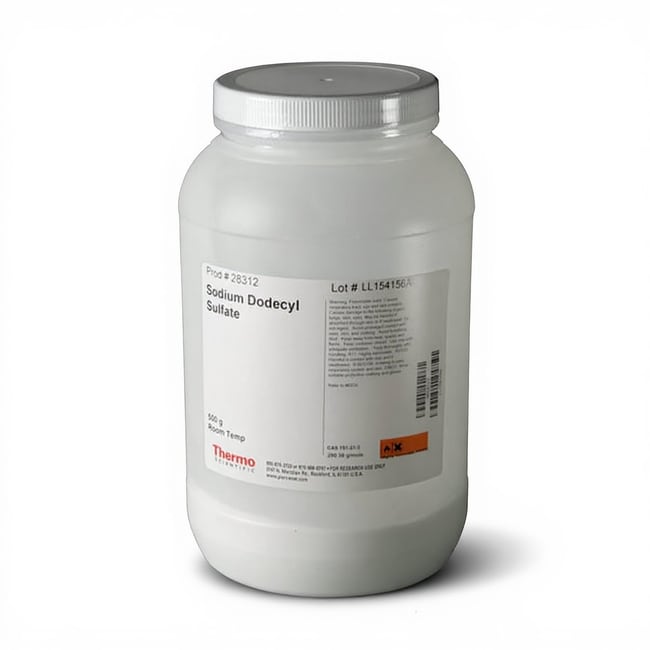
Thermo Scientific™ Sodium Dodecyl Sulfate (C12) is a highly purified form of SDS that is especially suited for protein experiments requiring tightly controlled solubility parameters.
Sodium dodecyl sulfate (SDS) is an alkyl sulfate, anionic detergent used frequently in protein electrophoresis and protein solubilization methods. It is a component of many cell lysis buffer formulations, including RIPA buffer. Typical SDS or lauryl sulfate preparations are mixture of several different chain lengths (C10 to C18). However, protein renaturation and other specialized methods require very specific surfactant and buffer conditions. This particular formulation of SDS is highly purified to eliminate nearly all secondary chain lengths besides C12.
Highlights:
- Popular anionic detergent for protein electrophoresis and solubilization
- Component of many cell lysis buffer formulations
- Specially purified formulation is >98% C12 alkyl sulfate
- Contains low levels of hexadecyl sulfate (C16), which inhibits protein renaturation
Detergent properties (pure C12):
- Molecular Weight: 288.5
- Detergent Class: Ionic (anionic)
- Aggregation Number: 62
- Micelle Molecular Weight: 18,000
- Critical Micelle Concentration (CMC): 6 to 8mM (0.1728 to 0.2304%, w/v)
- Cloud Point: >100°C
- Dialyzable: No

Specifications
Specifications
| Product Type | Detergent |
| Content And Storage | Store in original container protected from direct sunlight in a dry, cool and well-ventilated area, between the following temperatures: 20°C to 25°C. |
| Form | Powder |
| Reagent Type | Detergent (Pure) |
| Quantity | 500 g |
Safety and Handling


Product Identifier
- SODIUM DODECYL SULFATE (C12), SEQUANAL GRADE, 500 GMPKG
- Danger
- Acute toxicity Category 3
- Acute toxicity Category 4
- ACUTE AQUATIC Acute 1
- Serious eye damage/eye irritation Category 2
- Flammable solid Category 2
- Skin corrosion/irritation Category 2
- Specific target organ toxicity Category 3
- H228-Flammable solid.
- H302-Harmful if swallowed.
- H311-Toxic in contact with skin.
- H315-Causes skin irritation.
- H319-Causes serious eye irritation.
- H335-May cause respiratory irritation.
- H400-Very toxic to aquatic life.
- P210-Keep away from heat, hot surfaces, sparks, open flames and other ignition sources. No smoking.
- P261-Avoid breathing dust/fume/gas/mist/vapours/spray.
- P264-Wash hands thoroughly after handling.
- P273-Avoid release to the environment.
- P280-Wear protective gloves/protective clothing/eye protection/face protection.
- P301+P310-IF SWALLOWED: Immediately call a POISON CENTER/doctor /
- P302+P352-IF ON SKIN: Wash with plenty of water/soap.
- P304+P340-IF INHALED: Remove person to fresh air and keep comfortable for breathing.
- P305+P351+P338-IF IN EYES: Rinse cautiously with water for several minutes. Remove contact lenses, if present and easy to do. Continue rinsing.
- P370+P378-In case of fire: Use dry sand, dry chemical, or alcohol-resistant foam to extinguish.
- P403+P233-Store in a well-ventilated place. Keep container tightly closed.
- P501b-Dispose of contents/container in accordance with local/regional/national/international regulations.
- MIXTURE LIST-Contain: Sodium lauryl sulfate
For Research Use Only. Not for use in diagnostic procedures.
Product Title
By clicking Submit, you acknowledge that you may be contacted by Fisher Scientific in regards to the feedback you have provided in this form. We will not share your information for any other purposes. All contact information provided shall also be maintained in accordance with our Privacy Policy.
Spot an opportunity for improvement?