Learn More

Invitrogen™ Monkey IL-8 ELISA Kit
Description
Includes
Aluminium pouch(es) with a Microwell Plate coated with monoclonal antibody to monkey IL-8
Biotin-Conjugate anti-monkey IL-8 polyclonal antibody
Streptavidin-HRP
Monkey IL-8 Standard Concentrate, 125000 U/ml
Sample Diluent
Assay Buffer Concentrate 20x (PBS with 1% Tween 20 and 10% BSA)
Wash Buffer Concentrate 20x (PBS with 1% Tween 20)
Substrate Solution (tetramethyl-benzidine)
Stop Solution (1M Phosphoric acid)
Blue-Dye
Green-Dye
Red-Dye
Adhesive Films
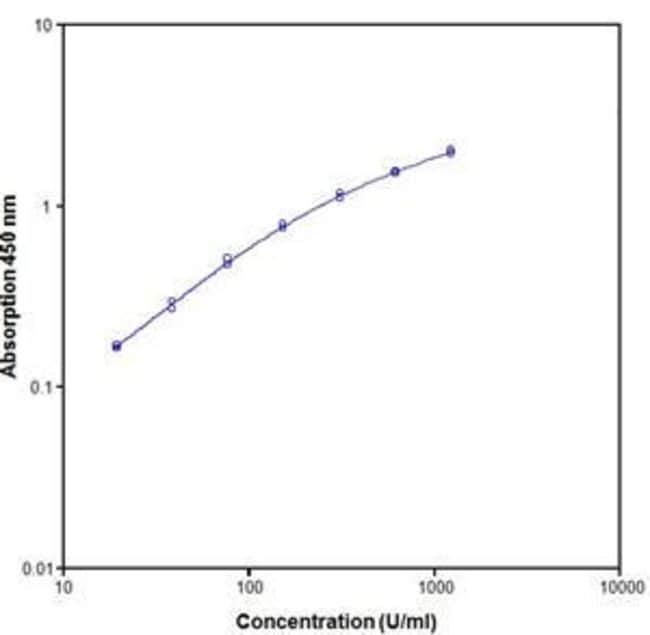
The Monkey Interleukin 8 (Mk IL-8) ELISA quantitates Mk IL-8 in cynomolus and baboon monkey serum or cell culture medium. The assay will exclusively recognize both natural and recombinant monkey IL-8. Principle of the method The Monkey IL-8 solid-phase sandwich ELISA (enzyme-linked immunosorbent assay) is designed to measure the amount of the target bound between a matched antibody pair. A target-specific antibody has been pre-coated in the wells of the supplied microplate. Samples, standards, or controls are then added into these wells and bind to the immobilized (capture) antibody. The sandwich is formed by the addition of the second (detector) antibody, a substrate solution is added that reacts with the enzyme-antibody-target complex to produce measurable signal. The intensity of this signal is directly proportional to the concentration of target present in the original specimen. Rigorous validation Each manufactured lot of this ELISA kit is quality tested for criteria such as sensitivity, specificity, precision, and lot-to-lot consistency. See manual for more information on validation.

Specifications
Specifications
| Assay Range | 19-1250 U/mL |
| Assay Sensitivity | 3.0 U/mL |
| Conjugate | HRP |
| Immunoassay Kit Format | Sandwich ELISA Kit |
| Product Type | ELISA |
| Sample Type | Serum, Supernatant |
| Target Species | Baboon, Cynomolgus Monkey |
| For Use With (Application) | ELISA |
| For Use With (Equipment) | Absorbance Microplate Reader |
| Gene Alias | (Ala-IL-8)77; (Ser-IL-8)72; Alveolar macrophage chemotactic factor I; alveolar macrophage-derived chemotactic factor-I; AMCF-I; ANX7; beta endothelial cell-derived neutrophil activating peptide; beta-thromboglobulin-like protein; chemokine (C-X-C motif) ligand 8; C-X-C motif chemokine 8; C-X-C motif chemokine ligand 8; CXCL8; cytokine 8; emoctakin; GCP/IL-8 protein I; GCP/IL-8 protein II; GCP/IL-8 protein III; GCP/IL-8 protein IV; GCP/IL-8 protein V; GCP/IL-8 protein VI; GCP1; GCP-1; Granulocyte chemotactic protein 1; IL8; IL-8; IL-8(1-77); IL-8(5-77); IL-8(6-77); IL-8(7-77); IL-8(8-77); IL-8(9-77); IL8/NAP1 form I; IL8/NAP1 form II; IL8/NAP1 form III; IL8/NAP1 form IV; IL8/NAP1 form V; IL8/NAP1 form VI; ILN; Interleukin; interleukin 8; Interleukin8; interleukin-8; interleuklin-8 precursor; LECT; LUCT; lung giant cell carcinoma-derived chemotactic protein; lymphocyte derived neutrophil activating peptide; Lymphocyte-derived neutrophil-activating factor; LYNAP; MDNCF; MDNCF-a; MDNCF-b; MDNCF-c; MONAP; Monocyte-derived neutrophil chemotactic factor; monocyte-derived neutrophil-activating peptide; NAF; NAP1; NAP-1; neutrophil activating peptide 1; neutrophil and T-lymphocyte chemotactic and activating factor; Neutrophil attractant/activation protein 1; neutrophil attractant/activation protein-1; Neutrophil-activating factor; neutrophil-activating peptide 1; Neutrophil-activating protein 1; Permeability factor 1; PF1; Protein 3-10C; RP11-537A6.8; RPF1; small inducible cytokine subfamily B, member 8; SNX; SYNEXIN; T-cell chemotactic factor; tumor necrosis factor-induced gene 1(Ala-IL-8)77; (Ser-IL-8)72; Alveolar macrophage chemotactic factor I; alveolar macrophage-derived chemotactic factor-I; AMCF-I; ANX7; beta endothelial cell-derived neutrophil activating peptide; beta-thromboglobulin-like protein; chemokine (C-X-C motif) ligand 8; C-X-C motif chemokine 8; C-X-C motif chemokine ligand 8; CXCL8; cytokine 8; emoctakin; GCP/IL-8 protein I; GCP/IL-8 protein II; GCP/IL-8 protein III; GCP/IL-8 protein IV; GCP/IL-8 protein V; GCP/IL-8 protein VI; GCP1; GCP-1; Granulocyte chemotactic protein 1; IL8; IL-8; IL-8(1-77); IL-8(5-77); IL-8(6-77); IL-8(7-77); IL-8(8-77); IL-8(9-77); IL8/NAP1 form I; IL8/NAP1 form II; IL8/NAP1 form III; IL8/NAP1 form IV; IL8/NAP1 form V; IL8/NAP1 form VI; ILN; Interleukin; interleukin 8; Interleukin8; interleukin-8; interleuklin-8 precursor; LECT; LUCT; lung giant cell carcinoma-derived chemotactic protein; lymphocyte derived neutrophil activating peptide; Lymphocyte-derived neutrophil-activating factor; LYNAP; MDNCF; MDNCF-a; MDNCF-b; MDNCF-c; MONAP; Monocyte-derived neutrophil chemotactic factor; monocyte-derived neutrophil-activating peptide; NAF; NAP1; NAP-1; neutrophil activating peptide 1; neutrophil and T-lymphocyte chemotactic and activating factor; Neutrophil attractant/activation protein 1; neutrophil attractant/activation protein-1; Neutrophil-activating factor; neutrophil-activating peptide 1; Neutrophil-activating protein 1; Permeability factor 1; PF1; Protein 3-10C; RP11-537A6.8; RPF1; small inducible cytokine subfamily B, member 8; SNX; SYNEXIN; T-cell chemotactic factor; tumor necrosis factor-induced gene 1; IL8 |
| Show More |
Your input is important to us. Please complete this form to provide feedback related to the content on this product.