Learn More

Invitrogen™ SeeBlue™ Plus2 Pre-stained Protein Standard
Description
Includes
500μL (50 applications of 10μL each) provided in a plastic vial Loading Buffer consists of Tris-HCl, Formamide, SDS, and Phenol Red
The SeeBlue™ Plus2 Pre-Stained Standard contains 10 proteins: 8 blue-dyed and 2 with contrasting colors, providing easier band identification. It can be used with NuPAGE™, tris-glycine, and tricine gels.
- 10 polypeptides resolved into 8 blue and 2 colored bands in the range of 4 to 250kDa (depending upon the buffer system)
- Immediate, unambiguous band identification
- A ready-to-use format—no mixing, heating, or reducing required
- Gel Compatibility: Bolt Bis-Tris Plus Gels, NovexTricine Gels, NovexTris-Glycine Gels, NuPAGE Bis-Tris Gels, NuPAGE Tris-Acetate Gels
This standard is pre-reduced and does not contain reducing reagents in the loading buffer.
1D Gel Electrophoresis, Protein Gel Electrophoresis, Protein Gel Staining and Imaging, Proteins, Expression, Isolation and Analysis, Western Blotting
Order Info
Shipping Condition: Wet Ice

Specifications
Specifications
| Content And Storage | 500 μL (50 applications of 10 μL each) provided in a plastic vial. Loading Buffer consists of Tris-HCl, Formamide, SDS, and Phenol Red. Store at 4°C. |
| Detection Method | Colorimetric |
| Number of Markers | 10 |
| Ready to Load | Yes |
| Size Range | 3 to 200 kDa |
| Gel Compatibility | Bolt™ Bis-Tris Plus Gels, Novex™ Tricine Gels, Novex™ Tris-Glycine Gels, NuPAGE™ Bis-Tris Gels, NuPAGE™ Tris-Acetate Gels |
| Molecular Weight (g/mol) | 198, 98, 62, 49, 38, 28, 17, 14, 6, 3 kDa |
| Quantity | 500 μL |
| Shipping Condition | Wet Ice |
| Product Line | SeeBlue |
| Show More |
Frequently Asked Questions (FAQs)
The recommended storage condition for SeeBlue and SeeBlue Plus2 Pre-stained standards is at 4°C. Freeze-thaw cycles, which could result from the standards being shuttled between the bench and the freezer for each use, could degrade the standards over time. If the standards are to be frozen, aliquot them into single use volumes to avoid repeated freeze-thaw.
The molecular weight values that are stated in conjunction with our standards are given as "apparent" molecular weights. The differences between the apparent molecular weights and the published molecular weights are a result of the covalent attachment of dye to the proteins used in the marker. The bound dye molecules can carry a charge. Of course, this charge changes the ability of the SDS to bind to the protein in addition to contributing directly to the protein's charge. The result is a protein with an altered charge and consequent change in mobility within the gel.
This explains why the proteins in prestained markers run differently from their unstained counterparts. However, it fails to fully explain why there is further difference observed between the same marker in differing gel types (Tris-Glycine vs NuPAGE gels, for example). The reason for this disparity is the different pHs of the gel types. At higher pH values (Tris-Glycine gels), charges are more likely to be protonated. Meanwhile, at the lower, more neutral pH of a NuPAGE gel, the charges are more skewed towards deprotonation, giving the same stained proteins a more negative charge overall. In an SDS PAGE system, more negative charge means more mobility. This is why the same prestained protein will be "larger" on a Tris-Glycine gel than on a NuPAGE gel. In a NuPAGE gel, the lower (approximately neutral) pH causes more overall negative charge, making the apparent molecular weight much lower. This effect generally increases in magnitude with the size of the protein and is greatest with myosin due to the increased number of dye binding sites.
Unfortunately, we do not have an image reference of the SeeBlue Pre-stained Protein Standard (Cat. No. LC5625) run on a Tris-Glycine running system. However, the image below shows the SeeBlue Plus2 Pre-stained Protein Standard (Cat. No. LC5925) which shares most proteins with the original SeeBlue. All proteins should run according to this table except for phosphorylase, which is not included in the original SeeBlue Pre-Stained Protein Standard. 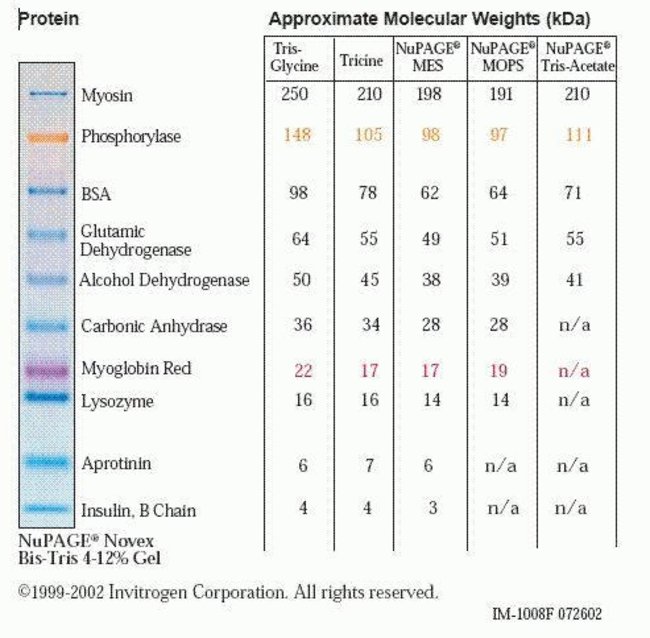
SeeBlue Plus2 Pre-Stained Standard includes 10 recombinant proteins, that resolve in the range of 4 to 250 kDa depending upon the buffer system being used. Please note that this pre-stained protein standard is not designed for quantitation and we do not recommend that you use this standard in the determination of protein concentration.
Estimations of the protein concentration for SeeBlue Plus2 is given below. However, these values are an approximation and should not be used to quantify samples.
Band per 10 µL: Myosin - 2.20 µg; Phosphorylase-b no estimation is available; BSA - 0.75 µg; GDH - 1.25 µg; Alcohol Dehydrogenase - 0.80 µg; Carbonic Anhydrase- 0.90 µg; Myoglobin (blue)* no estimation available; Lysozyme - 2.50 µg; Aprotinin - 1.80 µg and Insulin - 2.50 µg.
The fading is most likely due to detergent in the western blocking/washing solutions that can remove some of the proteins from the membrane. The dye itself will not wash off of the proteins because it is covalently bound. We have found that smaller pore size membranes retain the proteins better during blocking and wash procedures, and hence recommend use of 0.2 µm instead of 0.45 µm membranes for best resolution and protein retention. After transfer, it is a good idea to circle the pre-stained bands with a pencil on the membrane, so band positions can be identified after blocking and processing.
Safety and Handling

- SEEBLUE PLUS 2 PRE-STAINED STANDARD
- Danger
- Carcinogenicity Category 2
- Reproductive toxicity Category 1B
- Specific target organ toxicity after repeated exposure Category 2
- H351-Suspected of causing cancer.
- H360-May damage fertility or the unborn child.
- H373-May cause damage to organs.
- P201-Obtain special instructions before use.
- P202-Do not handle until all safety precautions have been read and understood.
- P260-Do not breathe dust/fume/gas/mist/vapours/spray.
- P280-Wear protective gloves/protective clothing/eye protection/face protection.
- P308+P313-IF exposed or concerned: Get medical advice/attention.
- P314-Get medical advice/attention if you feel unwell.
- P501b-Dispose of contents/container in accordance with local/regional/national/international regulations.
- MIXTURE LIST-Contain: formamide
For Research Use Only. Not for use in diagnostic procedures.
By clicking Submit, you acknowledge that you may be contacted by Fisher Scientific in regards to the feedback you have provided in this form. We will not share your information for any other purposes. All contact information provided shall also be maintained in accordance with our Privacy Policy.