missing translation for 'onlineSavingsMsg'
Learn More
Learn More


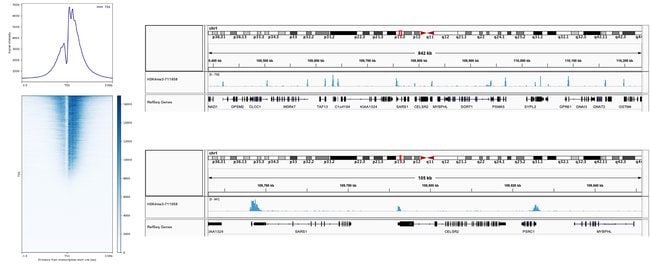

Invitrogen™ H3K4me3 Recombinant Polyclonal Antibody (9HCLC), ChIP-Verified, Invitrogen™
Rabbit Recombinant Polyclonal Antibody
Brand: Invitrogen™ 71195820UG
This item is not returnable.
View return policy
Description
This antibody is predicted to react with Rat. Recombinant rabbit polyclonal antibodies are unique offerings from Thermo Fisher Scientific. They are comprised of a selection of multiple different recombinant monoclonal antibodies, providing the best of both worlds - the sensitivity of polyclonal antibodies with the specificity of monoclonal antibodies - all delivered with the consistency only found in a recombinant antibody. While functionally the same as a polyclonal antibody - recognizing multiple epitope sites on the target and producing higher detection sensitivity for low abundance targets - a recombinant rabbit polyclonal antibody has a known mixture of light and heavy chains. The exact population can be produced in every lot, circumventing the biological variability typically associated with polyclonal antibody production.
Histone H3 is one of the DNA-binding proteins found in the chromatin of all eukaryotic cells. H3 along with four core histone proteins binds to DNA forming the structure of the nucleosome. Histones play a central role in transcription regulation, DNA repair, DNA replication and chromosomal stability. Post translationally, histones are modified in a variety of ways to either directly change the chromatin structure or allow for the binding of specific transcription factors. The N-terminal tail of histone H3 protrudes from the globular nucleosome core and can undergo several different types of post-translational modification that influence cellular processes. These modifications include the covalent attachment of methyl or acetyl groups to lysine and arginine amino acids and the phosphorylation of serine or threonine.
Specifications
| H3K4me3 | |
| Recombinant Superclonal | |
| 0.5 mg/mL | |
| PBS with 0.09% sodium azide; pH 7.4 | |
| P61830, P68431, P68433, P84228, Q71DI3 | |
| H3C1, H3C10, H3C12, H3C14, H3C15, H3C2, H3C7, HHT1 | |
| Peptide corresponding to human Tri-Methyl-Histone H3 (Lys 4). | |
| 20 μg | |
| Primary | |
| Human, Mouse, Rat, Yeast | |
| Antibody | |
| IgG |
| Peptide Array, ChIP Assay, ChIP sequencing (ChIP-seq), Western Blot, Immunocytochemistry | |
| 9HCLC | |
| Unconjugated | |
| H3C1 | |
| B0035.7; BUR5; CELE_T10C6.12; CG31613; CG31613-PA; CG33803; CG33806; CG33809; CG33812; CG33815; CG33818; CG33821; CG33824; CG33827; CG33830; CG33833; CG33836; CG33839; CG33842; CG33845; CG33848; CG33851; CG33854; CG33857; CG33860; CG33863; CG33866; Dmel\CG31613; Dmel_CG31613; F07B7.10; F07B7.3; F08G2.2; F17E9.13; F35H10.1; F45F2.4; F54E12.5; F55G1.10; H02I12.7; H3; H3 histone; H3 histone family, member A; H3 histone family, member I; H3 histone family, member K; H3 histone family, member L; H3 histone family, member M; H3 histone, family 2; H3 histone, family 3A; H3 histone, family 3B; H3 histone, family 3B (H3.3B); H3 histone, family 3B.1; H3 histone, family 3C; H3 K4; H3.1-221; H3.1-291; H3.1-I; H3.2; H3.2-221; H3.2-614; H3.2-615; H3.2-616; h3.2a; H3.3A; H3.3B; H3.5; H3/A; H3/b; H3/d; H3/f; H3/i; H3/j; H3/k; H3/l; H3/M; H3/n; H3/o; H3-143; H3-291; H3-3A; H3-3b; h3-5; H3-53; H3-614; H3a; H3b; H3-B; H3C1; H3C10; H3C11; H3C12; H3C2; H3C3; H3C4; H3C6; H3C7; H3c8; H3f; H3-F; H3F1K; H3F2; H3F3; h3f3a; H3F3B; h3f3b.1; H3F3C; h3f3d; H3FA; H3FB; H3FC HIST1H3C; H3FD; H3FF; H3FH; H3FI; H3FJ; H3FK; H3FL; H3FM; H3FN; H3g; H3h; H3i; H3K4; H3Lys4me3; h3r; HHT1; HHT2; his-12; his-16; his-19; his-21; His3; his-3; His3:CG31613; His3:CG31613-PA; His3:CG33803; His3:CG33806; His3:CG33809; His3:CG33812; His3:CG33815; His3:CG33818; His3:CG33821; His3:CG33824; His3:CG33827; His3:CG33830; His3:CG33833; His3:CG33836; His3:CG33839; His3:CG33842; His3:CG33845; His3:CG33848; His3:CG33851; His3:CG33854; His3:CG33857; His3:CG33860; His3:CG33863; His3:CG33866; his-30; his-33; his-43; his-47; his-51; his-53; his-57; his-61; his-65; his-68; his-7; Hist1; Hist1h3a; HIST1H3B; Hist1h3c; Hist1h3d; HIST1H3E; Hist1h3f; hist1h3g; hist1h3g.L; HIST1H3H; Hist1h3i; HIST1H3J; hist2h3; HIST2H3A; Hist2h3b; HIST2H3C; Hist2h3c1; Hist2h3c2; Hist2h3c2-ps; Hist2h3ca1; Hist2h3ca2; HIST2H3D; histone 1, H3a; histone 1, H3b; histone 1, H3f; histone 1, H3h; histone 2, H3a; histone 2, H3c; histone 2, H3c2; histone 2, H3ca2; Histone 3; histone cluster 1, H3a; histone cluster 1, H3b; histone cluster 1, H3f; histone cluster 1, H3g protein L homeolog; histone cluster 1, H3h; histone cluster 2, H3a; histone cluster 2, H3c; histone cluster 2, H3c2; histone cluster 2, H3c2, pseudogene; histone gene complex 1; Histone H2A; Histone H3; histone H3.1; Histone H3.2; histone H3.3; Histone H3.3C; histone H3.5; Histone H3/a; Histone H3/b; Histone H3/c; Histone H3/d; Histone H3/f; Histone H3/h; Histone H3/i; Histone H3/j; Histone H3/k; histone H3/l; Histone H3/m; histone H3/o; Histone H3K4me3; histone variant H3.5; hypothetical protein LOC550262; K06C4.11; K06C4.3; M32461; methyl Histone 3; methyl Histone H3; N2749; PP781; SIN2; T10C6.12; T23D8.6; Trimethyl H3; Tri-methyl H3; Trimethyl Histone H3; Tri-methyl Histone H3; Tri-Methyl-H3 K4; Tri-Methyl-H3 Lys4; Tri-Methyl-Histone H3 K4; Tri-Methyl-Histone H3 Lys4; wu:fa25h06; wu:fa96g06; wu:fb07a08; wu:fb36f01; XELAEV_18028537mg; YBR010W; YBR0201; YNL031C; zgc:110292; zgc:174300; zgc:56193; zgc:56418; zgc:64222; zgc:86731; ZK131.10; ZK131.6 | |
| Rabbit | |
| Protein A | |
| RUO | |
| 126961, 260423, 291159, 310678, 319150, 319152, 333932, 360198, 679994, 8350, 8356, 8357, 8358, 852295, 8968, 97114 | |
| Store at 4°C short term. For long term storage, store at -20°C, avoiding freeze/thaw cycles. | |
| Liquid |
Product Content Correction
Your input is important to us. Please complete this form to provide feedback related to the content on this product.
Product Title
Spot an opportunity for improvement?Share a Content Correction