Learn More


Invitrogen™ GFAP Monoclonal Antibody (GA5), eBioscience™, Invitrogen™
Description
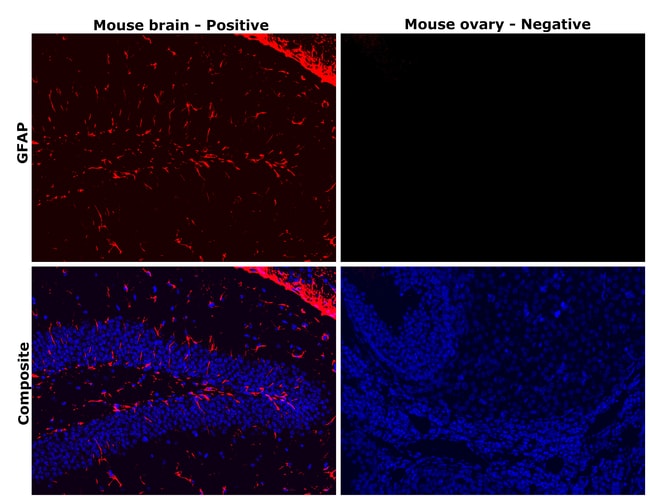
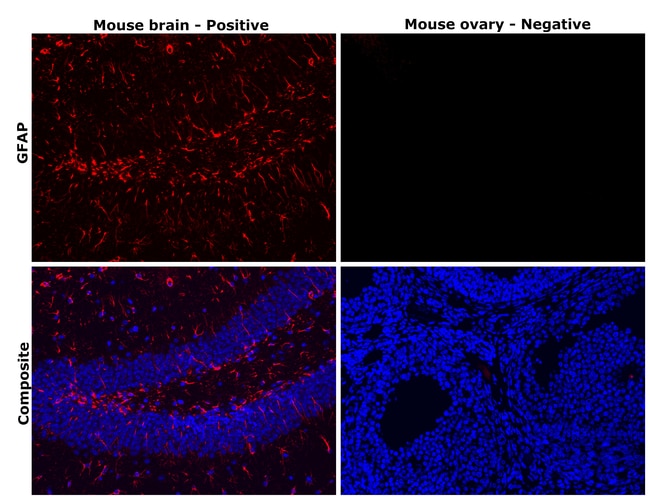
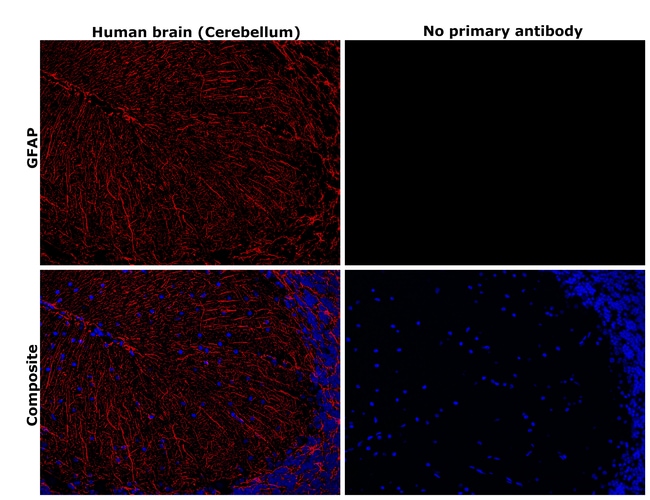
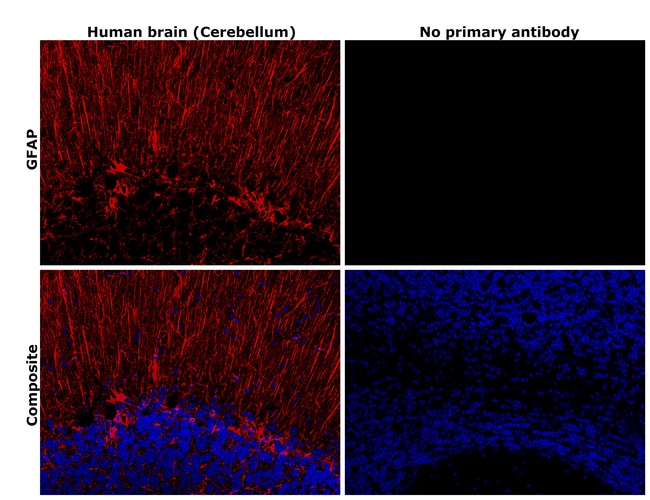
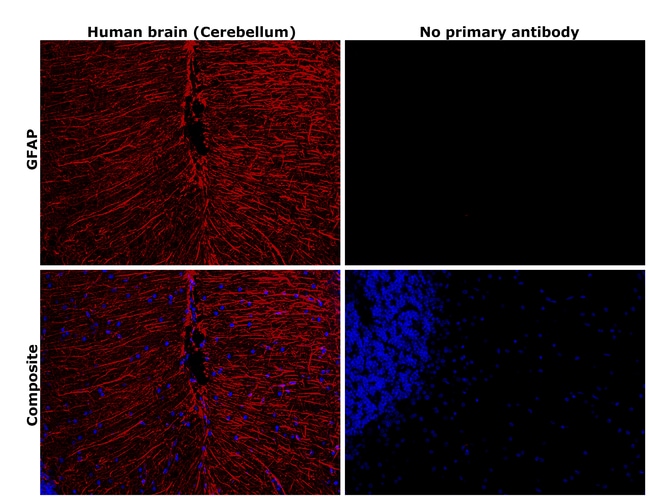
This GA5 MAb reacts with human, mouse, rat, chicken, rabbit, and pig glial fibrillary acidic protein (GFAP). This 49-kDa type III intermediate filament protein is expressed in neural tissues and distinguishes astrocytes from other glial cells during central nervous system development. Three alternative splice variants of GFAP exist; however, alpha-GFAP is the predominant form expressed in astrocytes. GFAP can co-assemble with vimentin and nestin in astrocytes, but such associations are not required for assembly. Like other intermediate filaments, GFAP assembly is dependent on phosphorylation and dephosphorylation of the N-terminal domain. Studies have demonstrated that mutations in the GFAP gene lead to Alexander disease. Moreover, GFAP has also been shown to be overexpressed in certain glial-derived tumors. Applications Reported: This GA5 antibody has been reported for use in immunocytochemistry, western blotting, immunohistochemical staining of formalin-fixed paraffin embedded tissue sections, and flow cytometric analysis. Applications Tested: This GA5 antibody has been tested by immunoblotting of lysate prepared from mouse brain, immunocytochemistry of fixed and permeabilized C6 cells, and immunohistochemistry of FFPE human tissue using low pH antigen retrieval. This can be used at less than or equal to 5 μg/mL. Purity: Greater than 90%, as determined by SDS-PAGE. Aggregation: Less than 10%, as determined by HPLC. Filtration: 0.2 μm post-manufacturing filtered.

Specifications
Specifications
| Antigen | GFAP |
| Applications | Flow Cytometry, Immunohistochemistry (Paraffin), Western Blot, Immunocytochemistry |
| Classification | Monoclonal |
| Clone | GA5 |
| Concentration | 0.5 mg/mL |
| Conjugate | Unconjugated |
| Formulation | PBS with 0.09% sodium azide; pH 7.2 |
| Gene | GFAP |
| Gene Accession No. | P03995, P14136, P47819 |
| Gene Alias | 6330404F12Rik; 65 kDa glutamic acid decarboxylase; AI836096; ALXDRD; Astrocyte or Intermediate Filament Protein; cb345; class III intermediate filament protein; etID36982.3; FLJ45472; GAD(65); Gad2; Gad-2; GAD65; GAD-65; GFAP; GFAP epsilon; gfap protein; gfapl; glial fibrillary acidic protein; Glial Fibrillary Acidic Protein (GFAP); glial fibrillary acidic protein alpha; glutamate decarboxylase 2; Glutamate decarboxylase 65 kDa isoform; glutamic acid decarboxylase 2; I79_011607; intermediate filament; intermediate filament protein; intermediate filament protein; GFAP; Unknown (protein for MGC:139638); wu:fb34h11; wu:fk42c12; xx:af506734; zgc:110485; zGFAP; intermediate filament protein; zrf-1 antigen |
| Show More |
By clicking Submit, you acknowledge that you may be contacted by Fisher Scientific in regards to the feedback you have provided in this form. We will not share your information for any other purposes. All contact information provided shall also be maintained in accordance with our Privacy Policy.