missing translation for 'onlineSavingsMsg'
Learn More

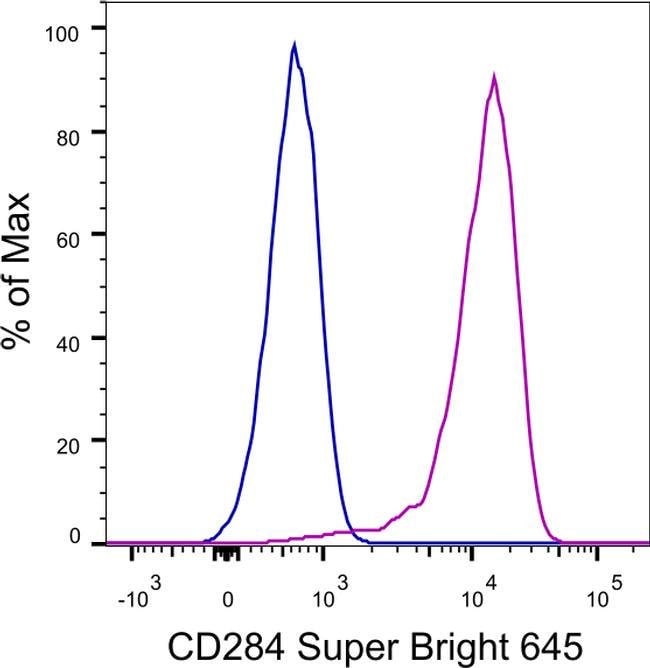
CD284 (TLR4) Monoclonal Antibody (HTA125), Super Bright™ 645, eBioscience™, Invitrogen™

Product Code. p-7145085
Change view
Click to view available options
Quantity:
100 Tests
25 Tests
Unit Size:
Pack of 100
Pack of 25
2 product options available for selection
Product selection table with 2 available options. Use arrow keys to navigate and Enter or Space to select.
Product Code. Quantity unitSize
16341594 25 Tests Pack of 25
16351594 100 Tests Pack of 100
Use arrow keys to navigate between rows. Press Enter or Space to select a product option. 2 options available.
2 options
This item is not returnable. View return policy
Product Code. 16341594 Supplier eBioscience Supplier No. 64991741

Please to purchase this item. Need a web account? Register with us today!

This item is currently unavailable or has been discontinued.
View the product page for possible alternatives.
View alternative products

This item is not returnable. View return policy

Mouse Monoclonal Antibody

Description: The 7E.17G9 monoclonal antibody reacts with mouse ICOS (Inducible COStimulatory molecule), a T cell specific molecule and a third member of the CD28/CTLA-4 family. A homodimer of 47-57 kDa, ICOS is expressed on activated T cells, has potent costimulatory activity for T cell activation and proliferation and is required for humoral immune response. ICOS binds to its ligand on activated APC including B cells called B7h/B7RP-1 and is thought to play a protective role in inflammatory autoimmune diseases. ICOS may be involved in the development of Th2 cells. Applications Reported: This 7E.17G9 antibody has been reported for use in flow cytometric analysis. Applications Tested: This 7E.17G9 antibody has been tested by flow cytometric analysis of mouse splenocytes. This may be used at less than or equal to 0.5 μg per test. A test is defined as the amount (μg) of antibody that will stain a cell sample in a final volume of 100 μL. Cell number should be determined empirically but can range from 10^5 to 10^8 cells/test. It is recommended that the antibody be carefully titrated for optimal performance in the assay of interest. Super Bright 645 is a tandem dye that can be excited with the violet laser line (405 nm) and emits at 645 nm. We recommend using a 660/20 bandpass filter. Please make sure that your instrument is capable of detecting this fluorochrome.

A test is defined as the amount (μg) of antibody that will stain a cell sample in a final volume of 100 μL. Cell number should be determined empirically but can range from 10^5 to 10^8 cells/test. Super Bright 645 is a tandem dye that can be excited with the violet laser line (405 nm) and emits at 645 nm. We recommend using a 660/20 bandpass filter. Please make sure that your instrument is capable of detecting this fluorochrome. When using two or more Super Bright dye-conjugated antibodies in a staining panel, it is recommended to use Super Bright Complete Staining Buffer (Product No. SB-4401) to minimize any non-specific polymer interactions. Please refer to the datasheet for Super Bright Staining Buffer for more information. Light sensitivity: This tandem dye is sensitive to photo-induced oxidation. Please protect this vial and stained samples from light. Fixation: Samples can be stored in IC Fixation Buffer (Product No. 00-8222) (100 μL of cell sample + 100 μL of IC Fixation Buffer) or 1-step Fix/Lyse Solution (Product No. 00-5333) for up to 3 days in the dark at 4°C with minimal impact on brightness and FRET efficiency/compensation. Some generalizations regarding fluorophore performance after fixation can be made, but clone specific performance should be determined empirically. Excitation: 405 nm; Emission: 645 nm; Laser: Violet Laser Super Bright Polymer Dyes are sold under license from Becton, Dickinson and Company. TLR4 is a member of the Toll like receptor (TLR) family which plays a fundamental role in pathogen recognition and activation of innate immunity. TLRs are highly conserved from Drosophila to humans and share structural and functional similarities. This receptor is most abundantly expressed in placenta, and in myelomonocytic subpopulation of the leukocytes. It has been implicated in signal transduction events induced by lipopolysaccharide (LPS) found in most gram-negative bacteria.
TRUSTED_SUSTAINABILITY

Specifications

Antigen CD284 (TLR4)
Applications Flow Cytometry
Classification Monoclonal
Clone HTA125
Concentration 5 μl/Test
Conjugate Super Bright 645
Formulation PBS with BSA and 0.09% sodium azide; pH 7.2
Gene TLR4
Gene Accession No. O00206
Gene Symbols TLR4
Host Species Mouse
Purification Method Affinity chromatography
Quantity 25 Tests
Regulatory Status RUO
Primary or Secondary Primary
Gene ID (Entrez) 7099
Target Species Human
Content And Storage 4° C, store in dark, DO NOT FREEZE!
Product Type Antibody
Form Liquid
Isotype IgG2a κ
Show More Show Less
Product Title
Select an issue

By clicking Submit, you acknowledge that you may be contacted by Fisher Scientific in regards to the feedback you have provided in this form. We will not share your information for any other purposes. All contact information provided shall also be maintained in accordance with our Privacy Policy.