All Primary Antibodies
Primary antibodies, immunoglobulins that bind to specific proteins or other biomolecules, are used in many research applications and protocols to detect targets of interest. They are developed using different animal hosts, including mouse, rat, rabbit, goat, sheep, and many others.
Monoclonal and Polyclonal Antibodies
One type of primary antibodies, monoclonal antibodies, provides high reproducibility and low cross-reactivity and background noise. Another type, polyclonal antibodies, often costs less and provides greater affinity and quicker binding. Both are produced using plasma B cells, but the former uses the same clone and the latter uses different clones. Monoclonal antibodies require hybridoma cell lines, and polyclonal antibodies do not.
There are also recombinant monoclonal antibodies with similar benefits, like high affinity, scalability, and specificity. They are produced using in vitro cloning of plasma B cells and expression hosts.
Conjugated Primary Antibodies
Antibodies can be labeled with various fluorophores or detection agents or used without labels. Labeled primary antibodies, also known as conjugated primary antibodies, help researchers simplify and streamline their applications. They are coupled with common enzymes and dyes such as Alexa Fluor and often used in protein and cell analysis.
Applications
Antibodies for life sciences applications are used in flow cytometry, western blotting, ELISA, immunohistochemistry, and immunocytochemistry. Secondary antibodies can be added to support the detection and purification of certain antigens. They bind to the primary antibody, which binds to the antigen of interest. Finding the right combination of antibodies can result in greater antigen specificity and a strong, detectable signal.
- (6)
- (59)
- (159)
- (145)
- (6)
- (213)
- (325)
- (10)
- (801)
- (14)
- (68)
- (2)
- (1)
- (528)
- (853)
- (147)
- (22)
- (1)
- (18)
- (2)
- (26)
- (26)
- (26)
- (26)
- (26)
- (26)
- (26)
- (26)
- (20)
- (25)
- (26)
- (26)
- (26)
- (26)
- (26)
- (26)
- (26)
- (26)
- (21)
- (21)
- (19)
- (26)
- (13)
- (13)
- (26)
- (19)
- (18)
- (2)
- (2)
- (2)
- (18)
- (285)
- (19)
- (19)
- (19)
- (652)
- (371)
- (2)
- (3)
- (1)
- (2)
- (760)
- (12)
- (1)
- (102)
- (50)
- (6)
- (1)
- (14)
- (14)
- (1)
- (13)
- (1)
- (22)
- (6)
- (9)
- (1)
- (2)
Filtered Search Results
Invitrogen™ F-actin Monoclonal Antibody (NH3)
Greener Choice Product
This product offers one or more environmental benefits itemized in the U.S. FTC Green Guides.
Learn More About the Greener Choice Program
This product offers one or more environmental benefits itemized in the U.S. FTC Green Guides.
Learn More About the Greener Choice Program
Mouse Monoclonal Antibody
| Content And Storage | Store at 4°C short term. For long term storage, store at -20°C, avoiding freeze/thaw cycles. |
|---|---|
| Target Species | Human,Mouse,Rat,Rabbit |
| Host Species | Mouse |
| Conjugate | Unconjugated |
| Applications | ELISA,Flow Cytometry,Immunohistochemistry (Frozen),Western Blot |
| Form | Liquid |
| Gene Accession No. | P29751, P60709, P60710, P60711 |
| Isotype | IgM |
| Concentration | 1 mg/mL |
| Antigen | F-actin |
| Gene Symbols | ACTB |
| Regulatory Status | RUO |
| Purification Method | Purified |
| Gene Alias | ACT; ACT-5; ACTB; ACTG; ACTG1; actin beta; actin gamma 1; actin, beta; actin, cytoplasmic 1; Actin, cytoplasmic 1, N-terminally processed; Actin, cytoplasmic 2; Actin, cytoplasmic 2, N-terminally processed; Actx; Atcb; beta cytoskeletal actin; beta-actin; BRWS1; BRWS2; cytoplasmic beta-actin; cytoskeletal gamma-actin; deafness, autosomal dominant 20; deafness, autosomal dominant 26; DFNA20; DFNA26; E430023M04Rik; epididymis luminal protein 176; gamma non-muscle actin; Gamma-actin; HEL-176; PS1TP5-binding protein 1; PS1TP5BP1 |
| Gene | ACTB |
| Product Type | Antibody |
| Gene ID (Entrez) | 100009272, 11461, 60, 81822 |
| Formulation | PBS with 0.09% sodium azide; pH 7.4 |
| Immunogen | Human monocytes and U937 cell line. |
| Classification | Monoclonal |
| Primary or Secondary | Primary |
| Clone | NH3 |
histidine ammonia-lyase, Mouse, Polyclonal Antibody, Abnova™
Mouse polyclonal antibody raised against a full-length human HAL protein.
glutamate-ammonia ligase (glutamine synthetase), Mouse, Clone: 3B6, Abnova™
Mouse monoclonal antibody raised against a partial recombinant GLUL.
histidine ammonia-lyase, Rabbit, Purified MaxPab™ Polyclonal Antibody, Abnova™
Rabbit polyclonal antibody raised against a full-length human HAL protein.
glutamate-ammonia ligase (glutamine synthetase), Rabbit, Purified MaxPab™ Polyclonal Antibody, Abnova™
Rabbit polyclonal antibody raised against a full-length human GLUL protein.
Actin Gamma 1 Antibody (NH3), Novus Biologicals™
Mouse Monoclonal Antibody has been used in 6 publications
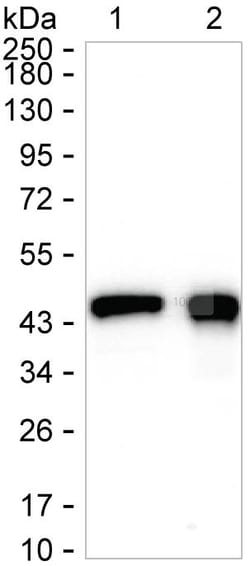
| Content And Storage | Store at 4C short term. Aliquot and store at -20C long term. Avoid freeze-thaw cycles. |
|---|---|
| Target Species | Human,Mouse,Rat,Rabbit |
| Host Species | Mouse |
| Conjugate | Unconjugated |
| Applications | Western Blot,Flow Cytometry,ELISA,Immunohistochemistry,Immunocytochemistry,Immunofluorescence,Immunohistochemistry (Frozen) |
| Form | Purified |
| Isotype | IgM |
| Gene Accession No. | P63261 |
| Concentration | 1.0 mg/mL |
| Antigen | F-Actin |
| Gene Symbols | ACTG1 |
| Regulatory Status | RUO |
| Purification Method | IgM purified |
| Dilution | Western Blot 1:100-1:500, Flow Cytometry 1:10, ELISA 1:10, Immunohistochemistry 1:10-1:500, Immunocytochemistry/Immunofluorescence 1:10-1:500, Immunohistochemistry-Frozen 1:10-1:500 |
| Gene Alias | actin, cytoplasmic 2, DFNA26, ACT, ACTG, actin, gamma 1, BRWS2, DFNA20 |
| Gene ID (Entrez) | 71 |
| Immunogen | Human monocytes and U937 cell line |
| Classification | Monoclonal |
| Primary or Secondary | Primary |
| Test Specificity | Recognizes human Filamentous actin (F-actin). The binds to the N-terminal region of actin, but not to the extreme N-terminal 40 amino acids. In tissue sections the stains the cytoplasm of macrophages strongly, and gives granular, localized nuclear staining of all cell types. |
| Clone | NH3 |
Invitrogen™ Glutamine Synthetase Polyclonal Antibody
Greener Choice Product
This product offers one or more environmental benefits itemized in the U.S. FTC Green Guides.
Learn More About the Greener Choice Program
This product offers one or more environmental benefits itemized in the U.S. FTC Green Guides.
Learn More About the Greener Choice Program
Rabbit Polyclonal Antibody
Glutamine Synthetase Recombinant Rabbit Monoclonal Antibody (23GB1345), Invitrogen™
Greener Choice Product
This product offers one or more environmental benefits itemized in the U.S. FTC Green Guides.
Learn More About the Greener Choice Program
This product offers one or more environmental benefits itemized in the U.S. FTC Green Guides.
Learn More About the Greener Choice Program
Rabbit Recombinant Monoclonal Antibody
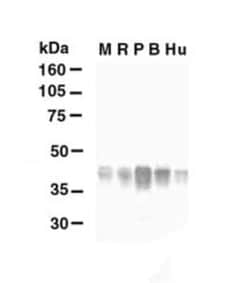
| Content And Storage | -20°C |
|---|---|
| Target Species | Human,Mouse,Rat |
| Host Species | Rabbit |
| Conjugate | Unconjugated |
| Applications | Flow Cytometry,Western Blot,Immunocytochemistry |
| Form | Liquid |
| Isotype | IgG |
| Gene Accession No. | P09606, P15104, P15105 |
| Antigen | Glutamine Synthetase |
| Regulatory Status | RUO |
| Purification Method | Affinity chromatography |
| Gene Alias | cell proliferation-inducing protein 59; GLNA; GLNS; Glul; GLUL protein; Glutamate ammonia ligase; glutamate decarboxylase; glutamate-ammonia ligase; glutamate--ammonia ligase; glutamate-ammonia ligase (glutamine synthase); glutamate-ammonia ligase (glutamine synthetase); glutamine synthase; glutamine synthetase; Glutamine synthetase (glutamate-ammonia ligase); glutamine synthetase 1; glutamine synthetase I; GS; Palmitoyltransferase GLUL; PIG43; PIG59; Proliferation inducing protein 43; proliferation-inducing protein 43 |
| Gene | GLUL |
| Product Type | Antibody |
| Gene ID (Entrez) | 14645, 24957, 2752 |
| Formulation | PBS with 50% glycerol and 0.02% sodium azide; pH 7.4 |
| Immunogen | A synthesized peptide derived from human Glutamine Synthetase (260-310AA). |
| Classification | Recombinant Monoclonal |
| Primary or Secondary | Primary |
| Clone | 23GB1345 |
Invitrogen™ Glutamine Synthetase Monoclonal Antibody (CL3013)
Greener Choice Product
This product offers one or more environmental benefits itemized in the U.S. FTC Green Guides.
Learn More About the Greener Choice Program
This product offers one or more environmental benefits itemized in the U.S. FTC Green Guides.
Learn More About the Greener Choice Program
Mouse Monoclonal Antibody
Invitrogen™ Glutamine Synthetase Polyclonal Antibody
Greener Choice Product
This product offers one or more environmental benefits itemized in the U.S. FTC Green Guides.
Learn More About the Greener Choice Program
This product offers one or more environmental benefits itemized in the U.S. FTC Green Guides.
Learn More About the Greener Choice Program
Rabbit Polyclonal Antibody
Invitrogen™ Glutamine Synthetase Monoclonal Antibody (CL2999)
Greener Choice Product
This product offers one or more environmental benefits itemized in the U.S. FTC Green Guides.
Learn More About the Greener Choice Program
This product offers one or more environmental benefits itemized in the U.S. FTC Green Guides.
Learn More About the Greener Choice Program
Mouse Monoclonal Antibody
Invitrogen™ Glutamine Synthetase Recombinant Rabbit Monoclonal Antibody (K01_1L26)
Greener Choice Product
This product offers one or more environmental benefits itemized in the U.S. FTC Green Guides.
Learn More About the Greener Choice Program
This product offers one or more environmental benefits itemized in the U.S. FTC Green Guides.
Learn More About the Greener Choice Program
Rabbit Recombinant Monoclonal Antibody
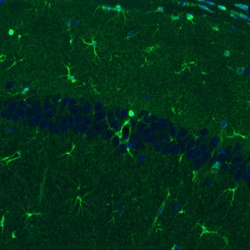
| Content And Storage | Maintain refrigerated at 2-8°C for up to 1 month. For long term storage store at -20°C |
|---|---|
| Target Species | Mouse,Rat |
| Host Species | Rabbit |
| Conjugate | Unconjugated |
| Applications | Immunoprecipitation,Western Blot |
| Form | Liquid |
| Gene Accession No. | P09606, P15105 |
| Isotype | IgG |
| Concentration | 1 mg/mL |
| Antigen | Glutamine Synthetase |
| Gene Symbols | GLUL |
| Regulatory Status | RUO |
| Purification Method | Protein A/G |
| Gene Alias | cell proliferation-inducing protein 59; GLNA; GLNS; Glul; GLUL protein; Glutamate ammonia ligase; glutamate decarboxylase; glutamate-ammonia ligase; glutamate--ammonia ligase; glutamate-ammonia ligase (glutamine synthase); glutamate-ammonia ligase (glutamine synthetase); glutamine synthase; glutamine synthetase; Glutamine synthetase (glutamate-ammonia ligase); glutamine synthetase 1; glutamine synthetase I; GS; Palmitoyltransferase GLUL; PIG43; PIG59; Proliferation inducing protein 43; proliferation-inducing protein 43 |
| Gene | GLUL |
| Product Type | Antibody |
| Gene ID (Entrez) | 14645, 24957 |
| Formulation | 50mM tris glycine with 0.05% BSA, 40% glycerol, 150mM NaCl and 0.01% sodium azide; pH 7.4 |
| Immunogen | A synthetic peptide of human Glutamine Synthetase. |
| Classification | Recombinant Monoclonal |
| Primary or Secondary | Primary |
| Clone | K01_1L26 |
Invitrogen™ Glutamine Synthetase Polyclonal Antibody
Greener Choice Product
This product offers one or more environmental benefits itemized in the U.S. FTC Green Guides.
Learn More About the Greener Choice Program
This product offers one or more environmental benefits itemized in the U.S. FTC Green Guides.
Learn More About the Greener Choice Program
Rabbit Polyclonal Antibody